The journey from a bold political vision to the world's tallest twin towers spanned nearly a decade. This visual timeline traces every major milestone — from the initial government brief in 1991 through the drama of construction, the record-breaking completion, and the towers' evolution into one of the most visited landmarks on Earth.
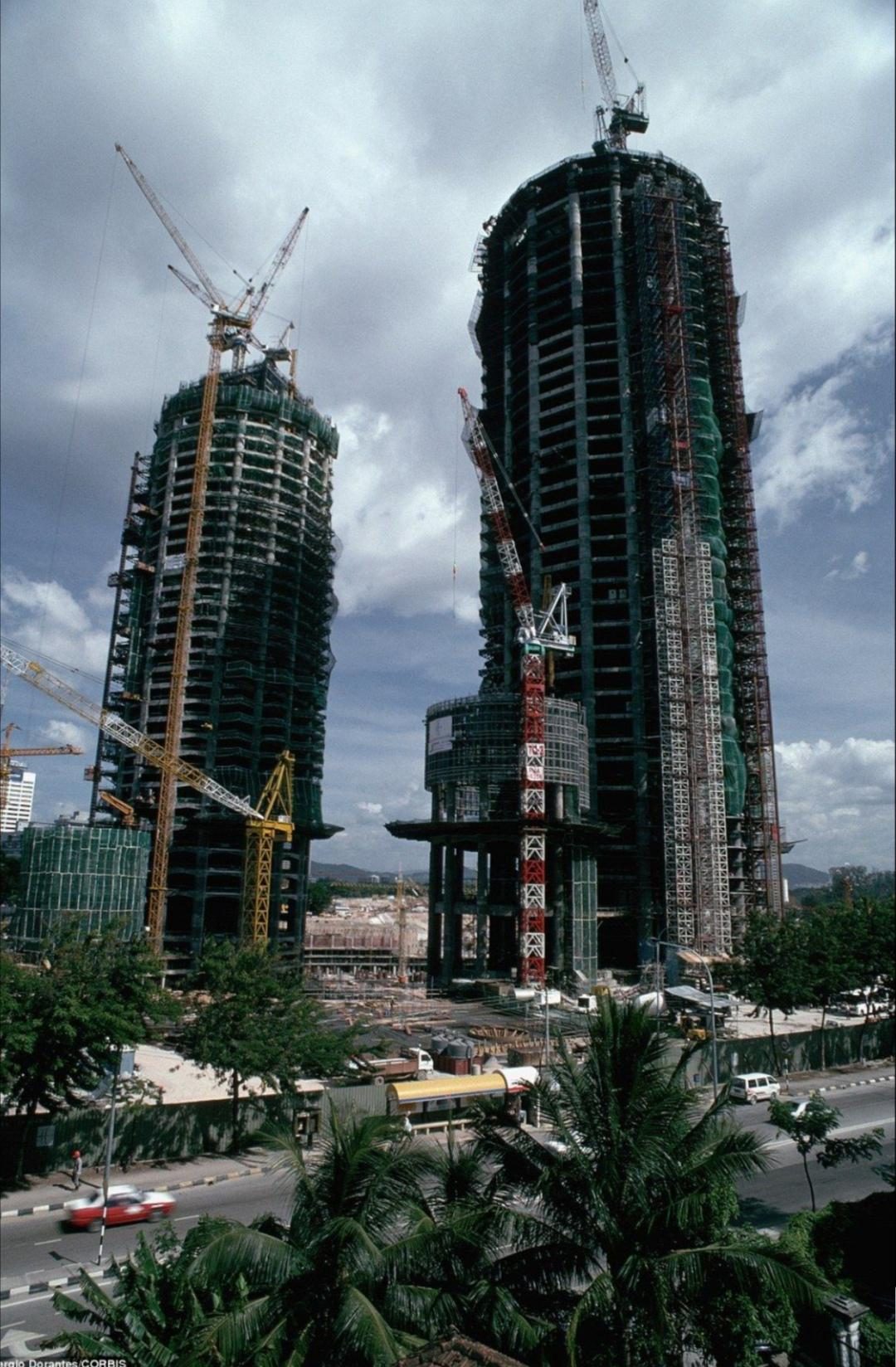
The towers rising above the Kuala Lumpur skyline during construction in the mid-1990s.
The Full Timeline
1991 — The Vision Takes Shape
Prime Minister Dr. Mahathir Mohamad announces plans for the Kuala Lumpur City Centre (KLCC) on the former Selangor Turf Club site. An international design competition is launched, attracting entries from eight leading architecture firms worldwide. The brief calls for twin towers that would serve as the headquarters of PETRONAS and anchor a 100-acre mixed-use development.
January 1992 — César Pelli Selected
The selection committee unanimously chooses the design submitted by César Pelli & Associates of New Haven, Connecticut. Pelli's proposal features twin towers with an eight-pointed-star floor plan derived from Islamic geometry, connected by a sky bridge at levels 41–42. The design is praised for its cultural sensitivity and bold visual impact.
1992–1993 — Planning and Geotechnical Work
Bore-hole surveys reveal highly uneven bedrock beneath the site. The entire project is shifted 60 metres southeast to find a more uniform limestone base. Engineers design unprecedented foundation rafts supported by friction piles driven up to 104 metres deep — among the deepest building foundations ever attempted at the time.
March 1993 — Ground Breaking
Construction officially begins. In an unusual arrangement, two separate main contractors are appointed: Hazama Corporation (Japan) for Tower 1 and Samsung Engineering & Construction (South Korea) for Tower 2. The dual-contractor structure creates an informal construction race that accelerates the schedule.
1993–1994 — Foundations and Core Construction
The massive foundation rafts are poured — each containing over 13,000 cubic metres of concrete, poured continuously over 54 hours in what are then the largest continuous concrete pours in Malaysian history. Core walls begin rising, using an innovative "jump-form" system that advances one floor every four days.
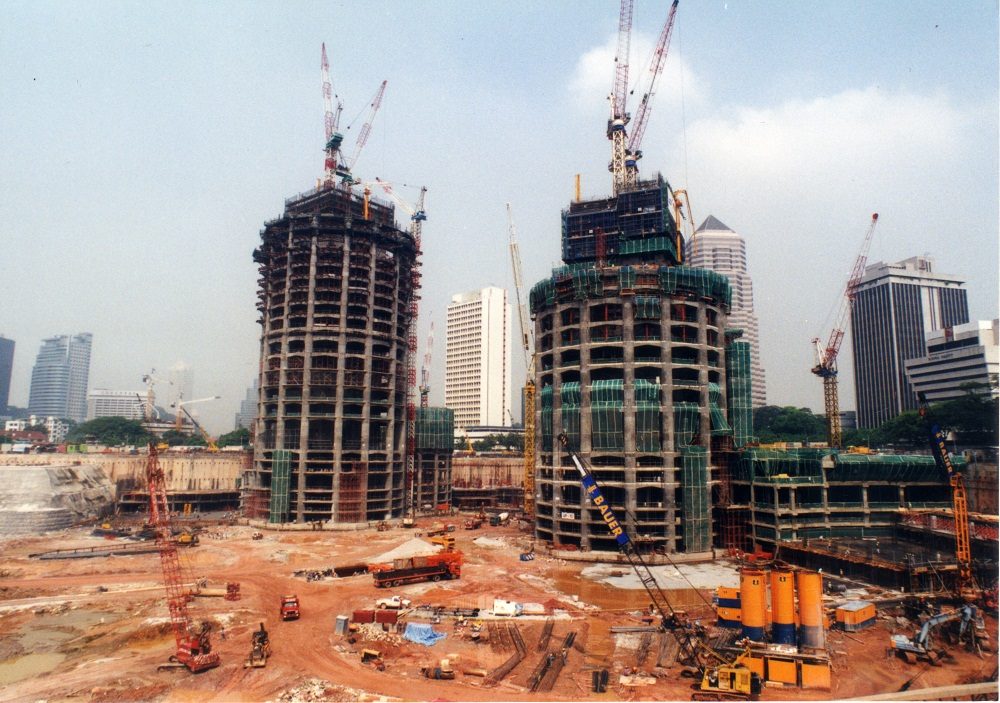
Both towers taking shape simultaneously during the intense construction period of 1994–1996.
1995 — Towers Rise Above the Skyline
By mid-1995, both towers have passed the 50th floor. The curtain wall installation follows close behind the structural work, cladding the towers in stainless steel and laminated glass as they climb. The race between Hazama and Samsung intensifies, with both teams working around the clock.
January 1996 — Skybridge Installation
In a dramatic weekend operation, the two halves of the 650-tonne sky bridge are lifted 170 metres into position using hydraulic strand jacks. Each half is raised over approximately 30 hours. Once connected, the bridge becomes the highest two-storey bridge in the world — a record it still holds.
March 1996 — Tower 2 Tops Out
Samsung Engineering completes Tower 2's structural frame, winning the informal construction race. Hazama Corporation follows with Tower 1 shortly afterwards. Both towers now stand at their full 88-storey height, awaiting the installation of the stainless-steel pinnacles that will push them past the Sears Tower's height record.
1996–1997 — Pinnacle Installation and Record
The 73.5-metre stainless-steel pinnacles are assembled in sections and lifted atop each tower. When the final segment is placed, the Petronas Twin Towers reach 451.9 metres — officially surpassing the Sears Tower (442.1 m) as the world's tallest building. The Council on Tall Buildings and Urban Habitat certifies the record in 1998.
1997 — Asian Financial Crisis
The Asian Financial Crisis strikes, sending currency values and stock markets plummeting across the region. Malaysia's economy contracts sharply, and critics question the wisdom of the mega-project. However, construction is already nearly complete, and the towers become a symbol of resilience — proof that the project will endure despite economic headwinds.
1 June 1999 — Official Opening
The Petronas Twin Towers are officially opened in a ceremony attended by Prime Minister Mahathir, PETRONAS executives, and international dignitaries. The Suria KLCC mall opens simultaneously, and the first tenants move into the office floors. Public access to the sky bridge begins the same month, immediately becoming one of Malaysia's most popular attractions.
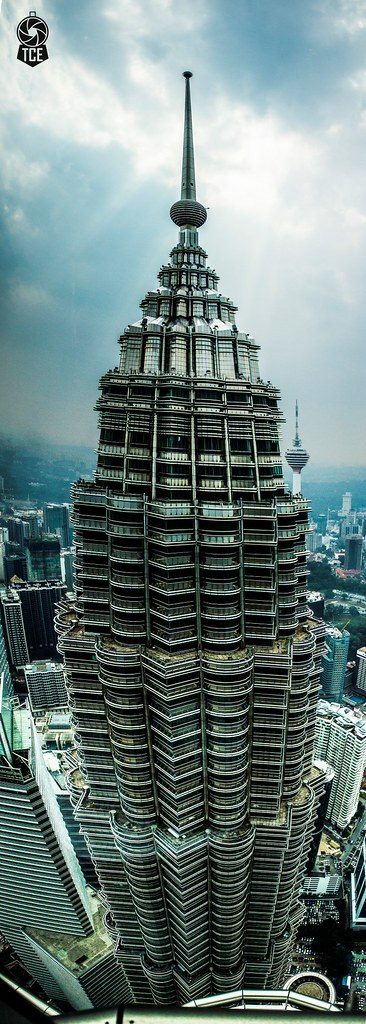
The completed towers at dusk — a landmark that transformed Malaysia's international image.
2004 — Height Record Surpassed
Taipei 101 in Taiwan overtakes the Petronas Towers as the world's tallest building at 508 metres. However, the Petronas Towers retain their record as the tallest twin towers in the world — a distinction that remains unchallenged to this day.
2004 — Aga Khan Award for Architecture
The Petronas Towers receive the prestigious Aga Khan Award for Architecture, recognising the project's sensitive integration of Islamic design principles into a modern skyscraper. The award committee praises the towers' cultural significance and their contribution to the built environment of the Muslim world.
2010 — Burj Khalifa Opens
The Burj Khalifa in Dubai opens at 828 metres, dwarfing all previous records. The Petronas Towers settle into their enduring role as the world's tallest twin towers and Malaysia's most iconic cultural landmark rather than a pure height record holder.
2019 — 20th Anniversary and Pelli's Passing
The towers celebrate their 20th anniversary with special lighting displays and cultural events. In July, architect César Pelli passes away aged 92 in New Haven, Connecticut. Tributes pour in from around the world, with the Petronas Towers cited universally as his masterwork.
2023 — Merdeka 118 Completed
Malaysia completes Merdeka 118 at 678.9 metres, becoming the second-tallest building in the world. The new tower is located nearby in the Tun Razak Exchange district, creating a dramatic double skyline with the Petronas Towers. Rather than being overshadowed, the older twins are reaffirmed as the emotional heart of the city.
2026 — Present Day
The Petronas Twin Towers continue to attract over two million visitors annually. PETRONAS remains the anchor tenant of Tower 1, while Tower 2 houses a roster of blue-chip multinational tenants. The KLCC precinct is widely regarded as the most successful mixed-use development in Southeast Asian history, and the towers remain — as Dr. Mahathir envisioned — the ultimate symbol of Malaysia on the world stage.
Timeline at a Glance
1991: Project announced · 1992: Pelli selected · 1993: Ground broken · 1996: Skybridge installed, towers topped out · 1998: Certified world's tallest · 1999: Officially opened · 2004: Height record surpassed, Aga Khan Award · 2019: 20th anniversary · 2026: Tallest twin towers, 2M+ annual visitors