Suspended 170 metres above street level, the Petronas Twin Towers' double-deck sky bridge is far more than a dramatic walkway between two office blocks. It is a feat of structural engineering that had to solve problems never before encountered in skyscraper construction — chiefly, how to build a rigid connection between two independently swaying towers without tearing itself apart.
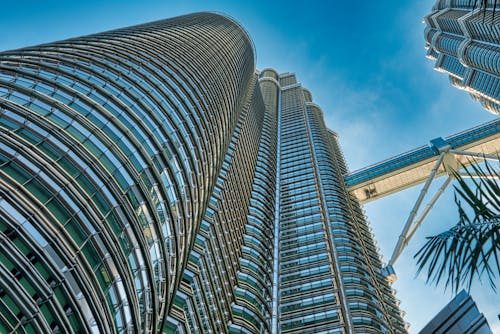
The sky bridge viewed from the KLCC esplanade, spanning 58 metres between the towers.
Why Build a Skybridge?
The concept of connecting the twin towers with a bridge was part of César Pelli's original competition entry in 1991. He envisaged the bridge as both a practical link — allowing occupants to move between towers without descending to ground level — and a powerful visual element that would frame the sky and create a "gateway" when viewed from the KLCC Park below. The idea was inspired in part by traditional Malay houses, which often feature covered walkways linking separate structures.
Beyond aesthetics, the bridge serves critical safety functions. In the event of a fire or emergency in one tower, occupants on the upper floors can cross to the other tower and use its evacuation systems — effectively doubling the available escape routes for levels above the bridge. Fire engineers considered this a significant improvement over single-tower designs, where occupants have no alternative vertical circulation once a stairwell is compromised.
Engineering Challenges
The fundamental challenge was movement. Each 88-storey tower sways independently under wind loads, thermal expansion, and seismic activity. At the 41st-floor level, the tip of each tower can move up to 300 millimetres relative to its base in strong winds. If the bridge were rigidly bolted to both towers, differential sway would generate enormous stresses, potentially cracking the structure or its connections.
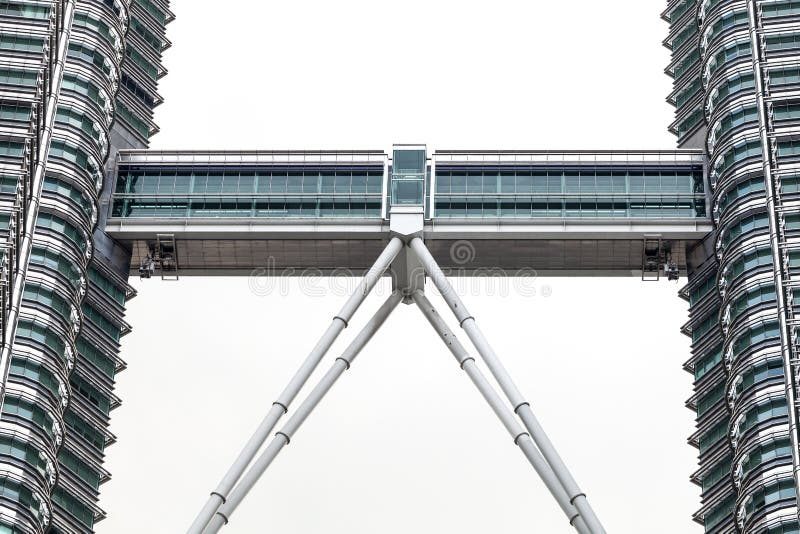
Looking up at the sky bridge from street level reveals the massive steel legs that support it.
Structural engineers at Thornton Tomasetti devised an elegant solution: the bridge sits on two massive chevron-shaped steel legs, each 26 metres long, which in turn rest on spherical bearings at the 29th floor of each tower. These bearings allow the bridge to slide horizontally, accommodating differential movements of up to 500 millimetres in any direction. The bridge is not fixed to the towers at its deck level; instead, it floats between them, transferring its weight downward through the angled legs to the tower cores below.
This "sliding" design means the bridge acts like a heavy pendulum that dampens rather than amplifies the towers' sway. Wind-tunnel tests at the University of Western Ontario confirmed that the bridge actually improves the dynamic behaviour of the overall structure, reducing peak accelerations experienced by occupants on upper floors.
Construction and Installation
The sky bridge was assembled at ground level in two halves, each weighing approximately 325 tonnes. In a carefully choreographed operation carried out over the weekend of 21–22 January 1996, hydraulic strand jacks lifted each half into position using cables threaded through the tower cores. The lift took roughly 30 hours per half, inching the steel sections upward at a rate of about six metres per hour.
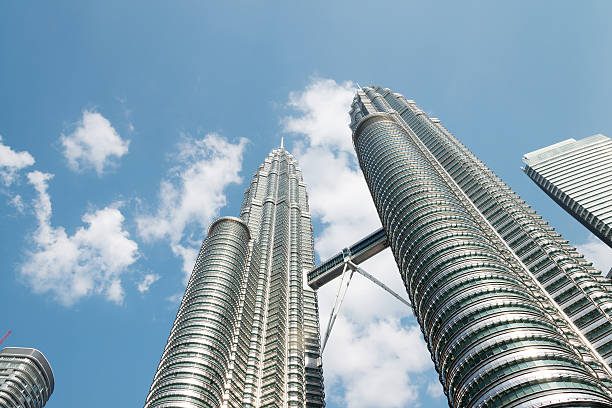
The completed sky bridge integrates seamlessly into the towers' architectural profile.
Once both halves were in position, workers bolted them together in the centre, completing the 58.4-metre span. The chevron legs were then jacked into their final positions on the spherical bearings. The entire installation was one of the most complex heavy-lift operations ever attempted in high-rise construction, and it was completed without a single lost-time injury.
Structural Design and Materials
The bridge consists of a steel-truss structure clad in the same stainless-steel-and-glass curtain wall used on the tower facades. Its double-deck configuration provides approximately 750 square metres of usable floor area across the two levels. The upper deck (Level 42) houses a visitor viewing gallery and a small exhibition space, while the lower deck (Level 41) contains the structural walkway and service corridors.
Key structural members are fabricated from high-strength low-alloy steel, chosen for its superior strength-to-weight ratio. The chevron legs are hollow box sections filled with concrete for added stiffness and fire resistance. The spherical bearings at their bases are made of chrome-plated steel, machined to tolerances of less than 0.1 millimetre to ensure smooth sliding under load.
Visitor Experience on the Skybridge
Today, the sky bridge is one of the most popular tourist attractions in Kuala Lumpur. Visitors who book the Petronas Twin Towers tour begin at the ground-floor ticketing hall and ascend by high-speed lift to Level 41. The bridge itself offers floor-to-ceiling glazing on both sides, providing panoramic views northward toward the KL Tower and southward toward the emerging skyscrapers of Tun Razak Exchange.
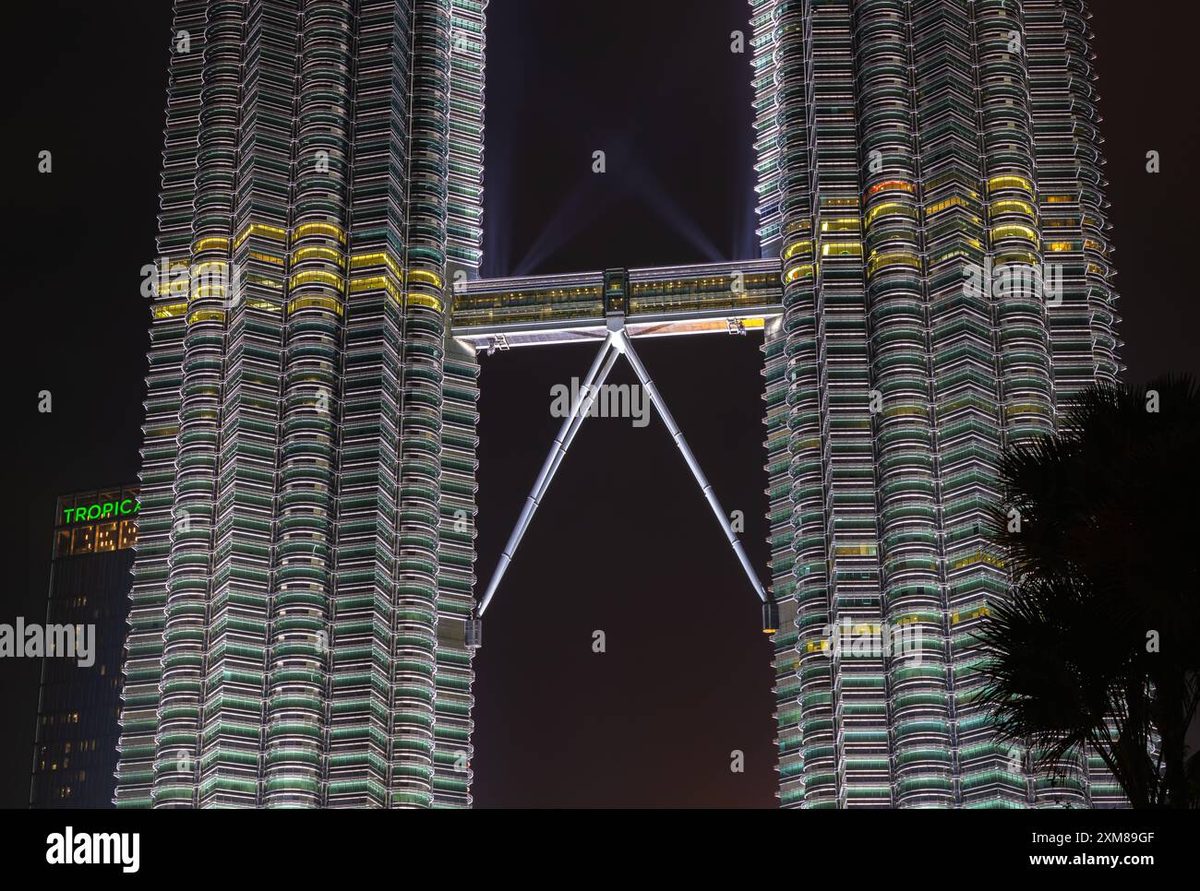
At night, the sky bridge is brilliantly illuminated, creating one of KL's most photographed sights.
Guided commentary explains the engineering story, and several interactive displays allow visitors to understand the sliding-bearing mechanism. The average visit to the sky bridge lasts about 15 minutes before groups are ushered onward to the Observation Deck at Level 86. Photography is permitted throughout, and the bridge provides some of the most unique vantage points in the city — looking straight down the canyon between the towers is a vertiginous thrill.
Skybridge Key Specifications
Height: 170 m (Level 41–42) · Span: 58.4 m · Weight: ~650 tonnes (both halves) · Support: Chevron legs on spherical bearings · Movement tolerance: ±500 mm horizontal · Installed: January 1996 · Lift duration: ~30 hours per half