When the Petronas Twin Towers claimed the title of world's tallest building in 1998, they ended a 25-year American monopoly on the record. Although they have since been surpassed in height, the towers remain in elite company — and in several categories they still hold records. Here we compare the Petronas Towers with some of the most celebrated skyscrapers on the planet.
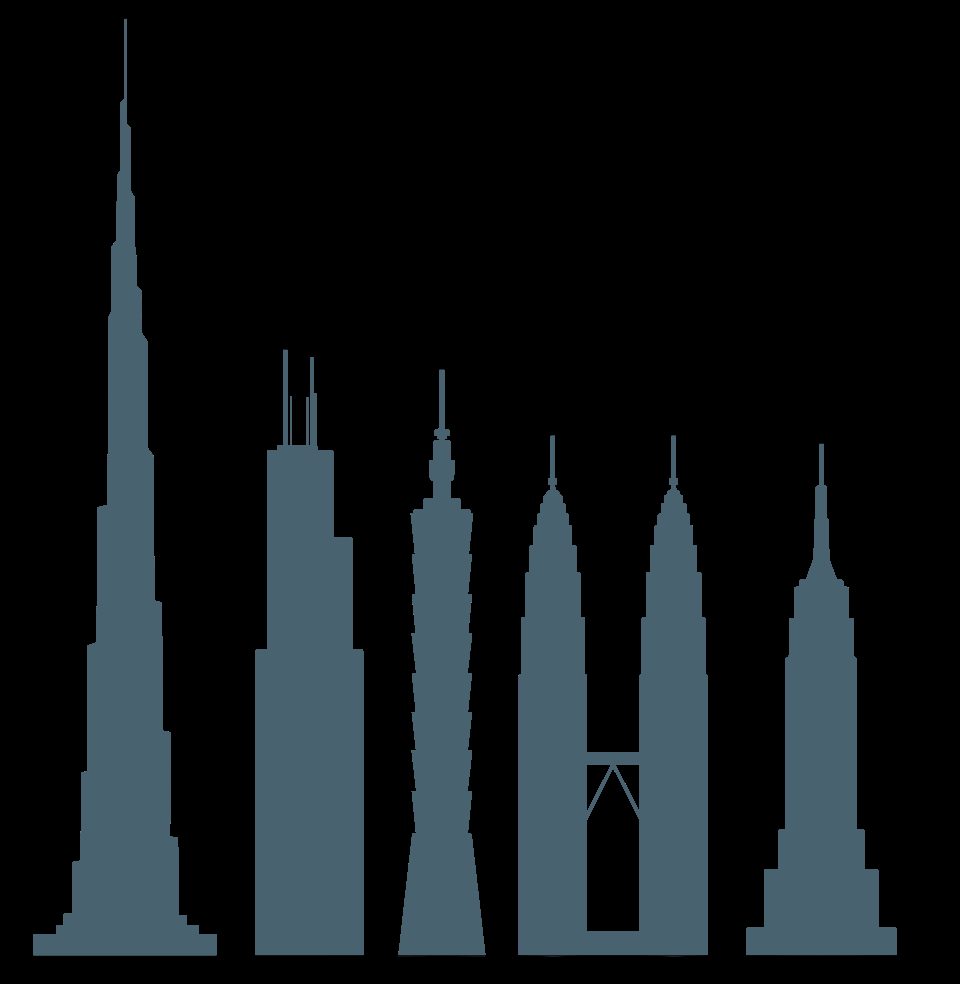
A scale comparison of the world's most famous supertall skyscrapers.
Height Comparisons
At 451.9 metres to the tip of their stainless-steel pinnacles, the Petronas Towers held the height record from 1998 until 2004, when Taipei 101 in Taiwan surpassed them at 508 metres. The record then passed to the Burj Khalifa in Dubai, which at 828 metres remains the world's tallest building. Despite these surpassings, the Petronas Towers retain the record as the tallest twin towers in the world — a distinction no other structure has challenged.
A comparison of roof heights rather than pinnacle heights tells a different story. The Petronas Towers' highest occupied floor sits at approximately 375 metres, comparable to the Willis Tower's 412-metre roof (formerly the Sears Tower). The Burj Khalifa's highest occupied floor is around 585 metres, while Shanghai Tower reaches roughly 561 metres. These figures highlight that the Petronas Towers' pinnacles contribute significantly to their overall height, a design choice that generated controversy when the Council on Tall Buildings and Urban Habitat (CTBUH) had to revise its measurement rules.
Architectural Style
Where many supertall buildings adopt a glass-curtain-wall aesthetic — sleek, reflective, and culturally neutral — the Petronas Towers stand apart through their explicit cultural identity. The Islamic geometry of the floor plan, the setback profile reminiscent of traditional Malay architecture, and the warm tone of the stainless-steel cladding give them a personality that is immediately distinguishable from, say, the crystalline minimalism of One World Trade Center or the neo-futurism of the Shanghai Tower.
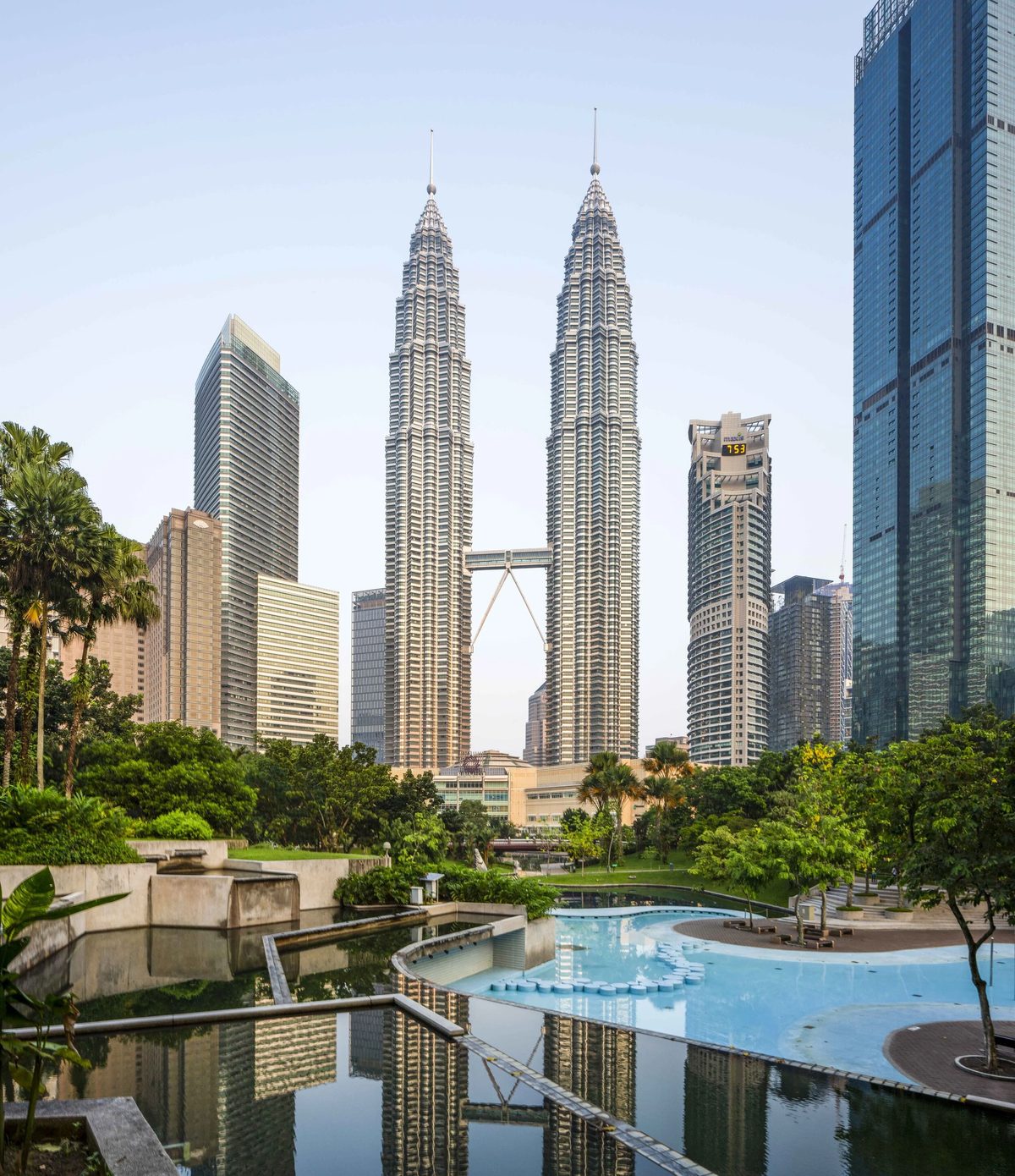
The towers' unique silhouette — tapered, pinnacled, and doubled — remains unmatched among supertall structures.
Taipei 101 drew on Chinese pagoda symbolism with its eight-section bamboo-like form. The Burj Khalifa's Y-shaped plan was inspired by the desert flower Hymenocallis. Willis Tower's bundled-tube design was purely structural in origin. Each approach reflects a different philosophy: cultural expression, biomorphic metaphor, or engineering optimisation. The Petronas Towers' achievement is to satisfy all three simultaneously.
Engineering Innovations
Every landmark skyscraper introduces structural innovations. The Empire State Building (1931) pioneered fast-track steel construction. Willis Tower (1973) introduced the bundled-tube concept. The Petronas Towers contributed their own advances: the use of high-strength reinforced concrete as the primary structural material (rather than steel), the world's deepest building foundations at the time (piles driven 104 metres into limestone), and the unprecedented sliding sky bridge.
The decision to use concrete rather than a conventional steel frame was both economic and pragmatic — concrete was cheaper and more readily available in Malaysia, and the material's mass provided excellent damping against wind-induced vibrations. This choice influenced later supertall projects in Asia, including Taipei 101 and many towers in the Middle East, which also favoured concrete-core construction.
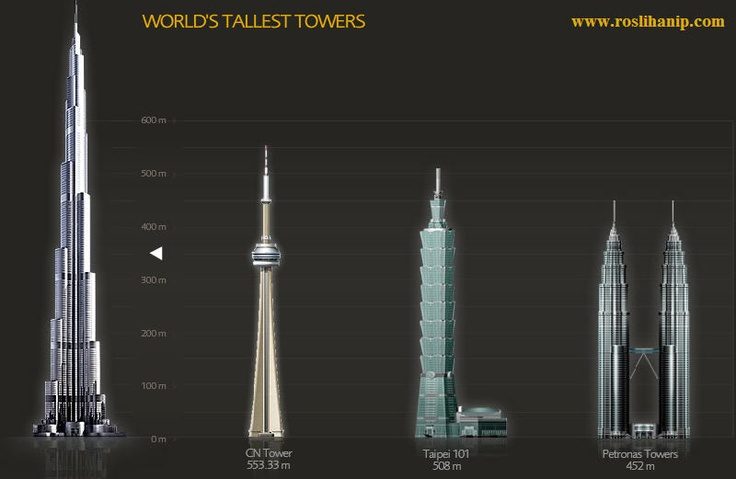
The Burj Khalifa dwarfs every other skyscraper, but the Petronas Towers' twin silhouette remains uniquely dramatic.
Quick Comparison Table
| Building | Location | Height | Floors | Completed |
|---|---|---|---|---|
| Petronas Twin Towers | Kuala Lumpur | 451.9 m | 88 | 1998 |
| Burj Khalifa | Dubai | 828 m | 163 | 2010 |
| Shanghai Tower | Shanghai | 632 m | 128 | 2015 |
| Merdeka 118 | Kuala Lumpur | 678.9 m | 118 | 2023 |
| Taipei 101 | Taipei | 508 m | 101 | 2004 |
| Willis Tower | Chicago | 442.1 m | 110 | 1973 |
| One World Trade Center | New York | 541.3 m | 104 | 2014 |
| Empire State Building | New York | 443.2 m | 102 | 1931 |
Historical Significance
Each of these buildings marked a turning point. The Empire State Building symbolised American resilience during the Depression. Willis Tower embodied Midwest corporate ambition. Taipei 101 announced the arrival of the Asian Tiger economies. The Burj Khalifa represented Dubai's ambition to become a global city. The Petronas Towers' historical significance is threefold: they ended the West's monopoly on the tallest-building record, they demonstrated that Islamic cultural identity could be expressed at supertall scale, and they triggered a wave of ambitious skyscraper projects across Asia and the Middle East that continues to this day.
Notably, the Petronas Towers remain among the most visited skyscrapers in the world, welcoming over two million visitors annually — a figure that exceeds the Empire State Building's observation-deck attendance in most years. Their status as the tallest twin towers ensures they will retain a unique place in architectural history regardless of how many taller single towers are built in the future.
Records Still Held
Tallest twin towers: 451.9 m — unchallenged since 1998 · Highest two-storey sky bridge: 170 m · Deepest building foundations at time of construction: 104 m piles