The Petronas Twin Towers are far more than a pair of extremely tall buildings. They represent a remarkable confluence of cultural symbolism, postmodern architectural ambition, and pioneering structural engineering. Every element — from the geometry of the floor plan to the composition of the high-strength concrete — was chosen to serve both an aesthetic purpose and a technical one. This article unpacks the layers of thought and innovation embedded in their design.
Design Philosophy
When César Pelli won the 1991 design competition, he set out to create towers that would be unmistakably Malaysian. At the time, most supertall buildings borrowed heavily from the Western modernist tradition — rectangular glass boxes that could belong to any city. Pelli rejected that approach. He spent weeks studying the art, architecture, and craft traditions of the Malay world, and he drew particular inspiration from the intricate geometric patterns found in Islamic mosques, textiles, and metalwork throughout the region.
The result was a design rooted in what Pelli called "geometric formalism" — a postmodern philosophy that values decorative richness, cultural legibility, and human-scale detail alongside modern structural efficiency. The towers taper gracefully as they ascend, each setback creating a subtle visual rhythm that draws the eye upward. The stainless-steel cladding and vision glass were chosen not for their neutrality but for their ability to capture and reflect the tropical light, giving the buildings a warm, silvery glow that shifts throughout the day.
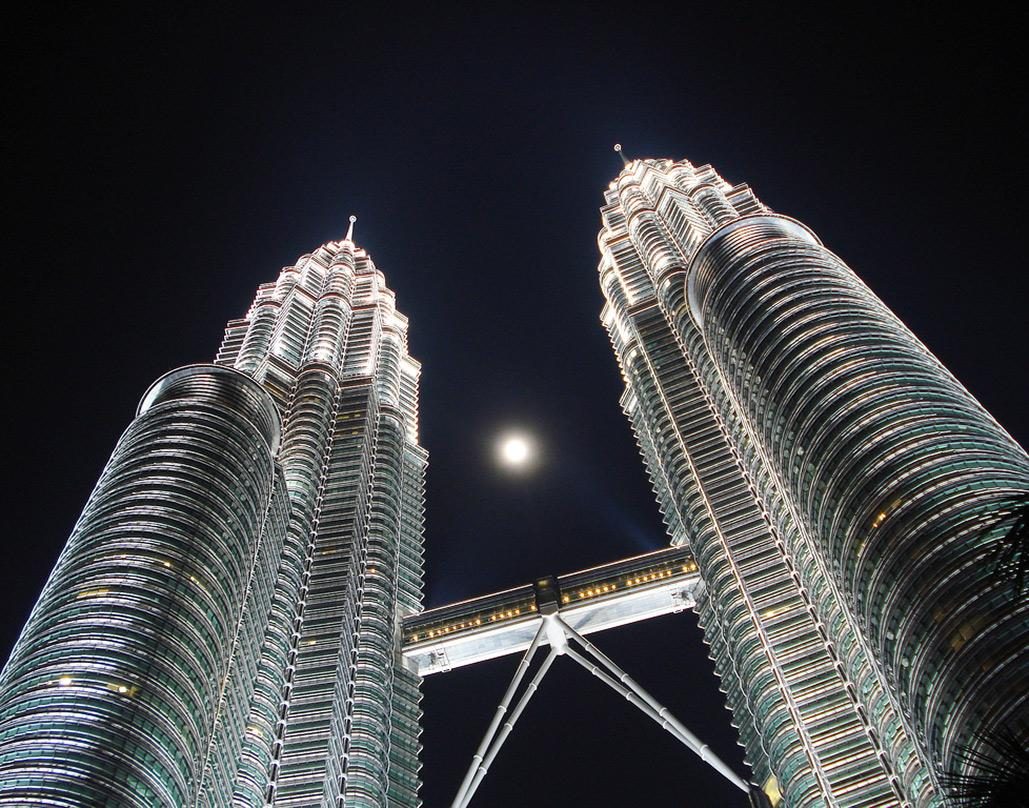
The tapering profile and stainless-steel cladding give the towers a distinctive, luminous quality.
Islamic Geometric Patterns
The most celebrated design element of the Petronas Twin Towers is their floor plan. Each tower is based on two rotated, superimposed squares that form an eight-pointed star — a pattern known in Islamic art as the Rub el Hizb. The points of the star are connected by small circular infills, softening the profile and creating 16 distinct corner conditions that provide exceptional panoramic views from the interior.
This geometry is not merely decorative. The eight-pointed star proved to be structurally advantageous as well, distributing gravity loads and lateral wind forces efficiently across a large footprint while maximising usable floor area. Each typical floor plate covers roughly 2,170 square metres — generous by supertall standards — yet the shape avoids the monotonous appearance of a simple circle or rectangle.
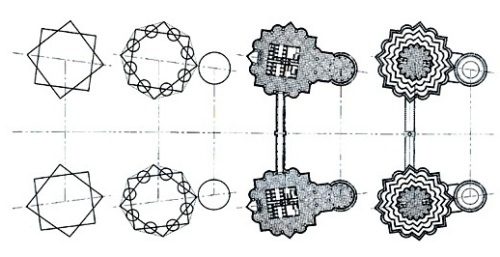
The floor plan: two overlapping squares create the iconic eight-pointed star with circular infills.
The same geometric vocabulary is carried throughout the building at every scale. The entrance lobbies feature marble floors laid in Islamic rosette patterns, the curtain-wall mullions echo the star motif, and even the elevator-lobby ceilings incorporate tessellated designs drawn from traditional Malay woodcarving. The consistency of this geometric language gives the towers a coherence that many contemporary skyscrapers lack.
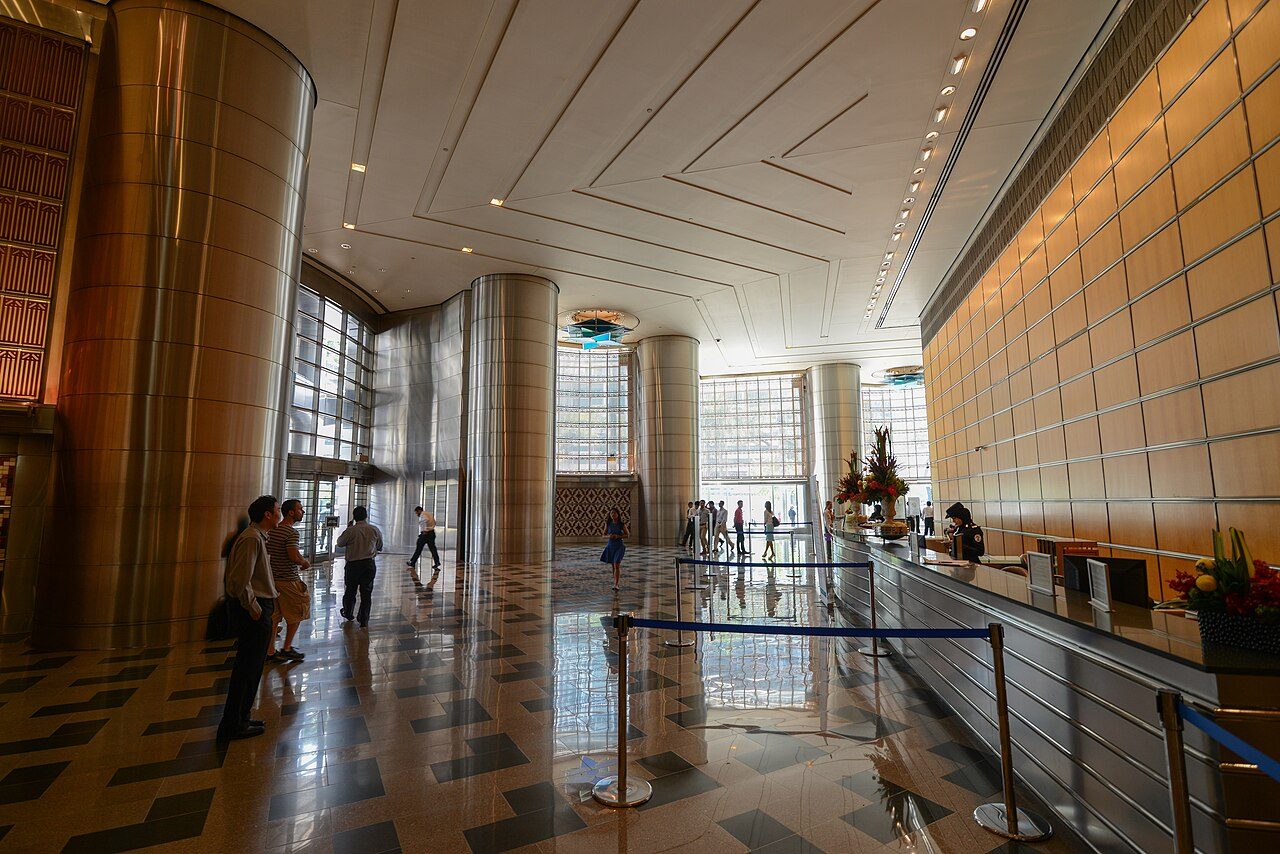
Intricate Islamic geometric patterns adorn the ceiling of the towers' grand foyer.
Structural Systems
Structurally, the Petronas Twin Towers pioneered several techniques that have since become standard in supertall construction. The primary structural system is a tube-in-tube arrangement: a massive reinforced-concrete core at the centre of each tower works in tandem with an outer ring of 16 large cylindrical concrete columns. Concrete was chosen over steel for the main structure primarily because of cost — at the time of construction, high-strength concrete was significantly cheaper in Malaysia than imported structural steel — but it also offered superior damping characteristics that help reduce occupant-perceptible sway.
The concrete used in the lower columns achieved compressive strengths of up to 80 megapascals, placing it among the highest-performance concretes used in any building at that time. A proprietary mix design incorporating Malaysian aggregates was developed specifically for the project by a team of local and international materials scientists.
Ring beams at each floor level tie the core to the outer columns, and a series of outrigger walls at mechanical floors (roughly every 12 storeys) further stiffen the structure against wind and seismic loads. The outriggers act like the spokes of a wheel, transferring bending moments from the core to the perimeter columns and dramatically reducing lateral drift at the top of the building.
Key Structural Numbers
Core wall thickness (base): 750 mm · Perimeter column diameter: 2.4 m · Concrete strength (max): 80 MPa · Total concrete volume: ~160,000 m³ per tower · Total structural steel: ~36,910 tonnes per tower · Wind design speed: 65 m/s (three-second gust)
Foundation Engineering
Beneath the gleaming towers lies one of the most remarkable foundation systems ever built. The original site survey discovered that competent bedrock — the Kenny Hill formation — was buried under layers of alluvium and weathered limestone (the Kuala Lumpur Limestone). Bedrock depth varied wildly, from as shallow as 40 metres to well over 200 metres, making it impractical to drive piles all the way to rock.
The solution was a system of barrette piles — rectangular, cast-in-place concrete elements measuring 2.8 m by 0.8 m — socketed into the stiff limestone at depths ranging from 40 to 104 metres. Each tower sits on a massive 4.6-metre-thick reinforced-concrete raft that spreads the building's weight across the tops of 104 barrette piles. The raft for each tower consumed roughly 13,200 cubic metres of concrete and was poured in a single continuous operation lasting more than 54 hours to avoid cold joints.
At the time of their construction, these were among the deepest friction-pile foundations ever created for a building. The geotechnical engineering was led by a consortium of Malaysian and international firms, and the approach they devised has since been studied and adapted for other projects built on similarly challenging tropical karst geology.
The Skybridge
Connecting the two towers at Levels 41 and 42 — approximately 170 metres above the ground — is the famed double-decker Skybridge. Designed by structural engineers at Thornton Tomasetti in collaboration with the architectural team, the bridge spans 58 metres and weighs approximately 750 tonnes.
The Skybridge is not rigidly attached to either tower. Instead, it rests on a spherical bearing at each end that allows it to slide horizontally as the towers sway independently in the wind. This ingenious articulation system prevents catastrophic stress transfer between the two structures. On a windy day, the two towers can sway as much as 300 millimetres in opposite directions; the bridge's bearings accommodate this movement invisibly.
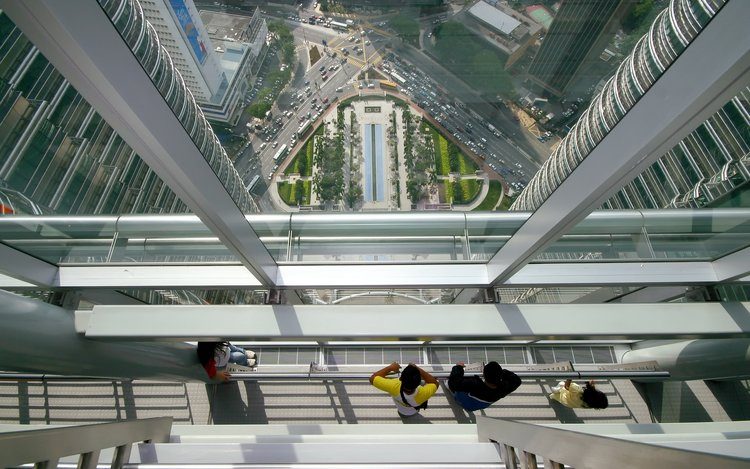
The Skybridge at Levels 41–42 — a 58-metre span supported by spherical bearings.
Installation of the Skybridge was a dramatic engineering feat in its own right. The structure was assembled at ground level and then lifted into position in three segments using strand jacks during two weekend closures of the surrounding streets in 1996. Each lift took roughly 12 hours, and the entire operation was watched by thousands of onlookers and covered live on Malaysian television.
Cladding and Materials
The exterior curtain wall is composed of approximately 83,500 square metres of stainless-steel panels and vision glass per tower. The stainless steel was chosen for its durability in Malaysia's humid tropical climate and for the warm, reflective quality it imparts — a deliberate contrast to the cold blue-glass aesthetic that dominated skyscraper design in the 1990s. Each panel was fabricated in Italy and shipped to Kuala Lumpur for installation, a logistical operation that required precise sequencing across multiple ocean freight shipments.
The vision glass is a laminated, tinted unit that reduces solar heat gain by approximately 50 percent compared to clear glass, significantly lowering the air-conditioning load. The mullion system incorporates deep aluminium extrusions that cast shadows reminiscent of the vertical lines in traditional Malay timber architecture.
Interior Design Highlights
Inside, the towers blend corporate modernity with generous helpings of Malaysian craftsmanship. The ground-floor lobbies are clad in Italian marble arranged in geometric rosettes, with bespoke stainless-steel elevator doors featuring etched Islamic patterns. Ceiling coffers in the main foyer are hand-painted with motifs drawn from songket weaving, one of Malaysia's most treasured textile traditions.
The Dewan Filharmonik Petronas, the 885-seat concert hall on the podium level, was acoustically designed by the firm Kirkegaard Associates and features a shoebox configuration regarded as one of the finest in Asia. Its interior is finished in Malaysian tropical hardwoods, with acoustic panels sculpted into wave-like forms that double as visual art.
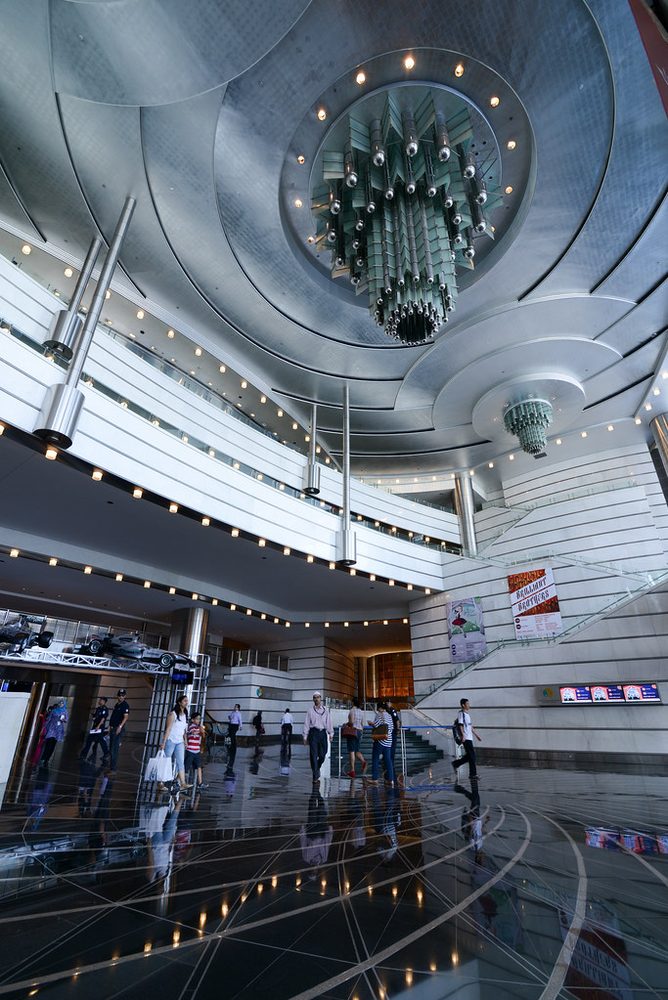
The towers' grand foyer merges Italian marble with Islamic geometric artistry.
Sustainability in the 21st Century
While the towers were designed and built before the era of green-building rating systems, their operators have progressively retrofitted them with modern sustainability technologies. The 2019 LED lighting upgrade reduced exterior illumination energy consumption by approximately 80 percent. Chilled-water systems have been optimised, low-flow fixtures installed in restrooms, and waste-diversion programmes introduced throughout the complex.
The KLCC Park surrounding the towers acts as an urban heat-island mitigator, with its dense canopy and large water features providing measurable cooling effects on surrounding air temperatures. The park was designed by the legendary Roberto Burle Marx and remains one of the largest purpose-designed tropical urban parks in Southeast Asia.
Related Reading
Learn how all of these design elements came together during the actual build in our Construction Story, or explore practical visitor information in the Visitor Guide.